


Exploring the American Museum of Natural History
Spanning four city blocks alongside Central Park on the Upper West Side, the American Museum of Natural History (AMNH) is a sprawling, 28-building complex. Because it is completely impossible to see all 45 permanent exhibition halls in a single day, the secret to a successful family visit is picking a few major wings and taking the time to actually experience them.
The Mignone Halls of Gems and Minerals


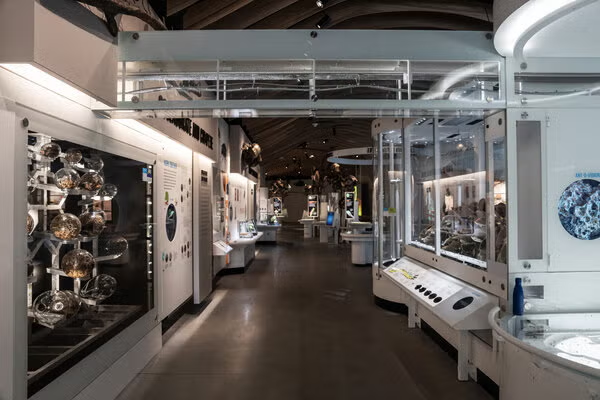
Completely redesigned and reopened in 2021, this 11,000-square-foot gallery is an absolute visual feast. The hall explores how mineral diversity arose on Earth, but the sheer beauty of the specimens is what captivates kids.
- The Geodes: Right at the entrance, you are greeted by two towering, purple amethyst geodes that are among the world’s largest on public display.
- The Star of India: Look for this legendary, golf-ball-sized blue sapphire, which weighs 563 carats and features a natural, star-like pattern inside the stone.
- The Fluorescence and Phosphorescence Room: A dedicated dark room where kids can watch seemingly ordinary, dull rocks light up in brilliant neon oranges, greens, and pinks under ultraviolet light.
The Iconic Animal Dioramas


Long before high-definition nature documentaries existed, the museum’s habitat dioramas were designed to show the public exactly how global wildlife lived in the wild.
- Akeley Hall of African Mammals: This jaw-dropping, two-story gallery features a herd of eight African elephants marching through the center. They are flanked by meticulously detailed dioramas showcasing lions, gorillas, and ostriches.
- Bernard Family Hall of North American Mammals: Located on the first floor, this wing is famous for its dramatic poses and stunning lighting. Highlights include a massive Alaskan brown bear standing fully upright on its hind legs and a family of mountain lions set against a perfectly rendered Grand Canyon backdrop.
The Giant Sequoia & Natural Forests

- The Giant Sequoia Tree Ring: Located in the Hall of North American Forests, visitors can walk right up to a massive cross-section of a Giant Sequoia that lived for over 1,400 years. The museum has mapped major historical events directly onto the tree rings, allowing kids to visually trace the passage of time from the year 500 CE all the way into the 19th century.
The Rose Center & Hayden Planetarium


Housed inside a massive glass cube on the north side of the campus, this wing focuses entirely on astrophysics and the origins of the universe.
- The Hayden Planetarium Space Theater: Located inside the top half of the giant sphere that seemingly floats in the center of the building, this theater features incredibly immersive space shows projected onto a massive dome screen.
- The Cosmic Pathway: A 360-foot spiral walkway that winds around the planetarium sphere, detailing the 13-billion-year history of the universe.
- The Willamette Meteorite: Sitting on the bottom floor of the Rose Center, this 15.5-ton iron-nickel space rock is completely exposed, allowing visitors to get an up-close look at real debris from the solar system.
Dinosaurs, Whales, and Insects





- The Milstein Hall of Ocean Life: Hanging from the ceiling of this bi-level, blue-lit room is the iconic 94-foot-long fiberglass Blue Whale. The space underneath the whale is carpeted and serves as an excellent spot for kids to sit, rest, and look up.
- The Richard Gilder Center & Insectarium: The museum’s newest wing looks like a massive canyon carved by water and wind. It houses the Susan and Peter J. Solomon Family Insectarium, where the undisputed highlight is one of the world’s largest live leafcutter ant colonies. You can watch thousands of ants actively marching and carrying leaves across a massive glass skybridge that stretches over your head. This wing also features the Davis Family Butterfly Vivarium, a climate-controlled room where up to 1,000 free-flying butterflies land on the pathway and visitors.
- The Fossil Halls: Beyond the famous Tyrannosaurus Rex mount, you absolutely must see the Titanosaur. This 122-foot-long cast of a newly discovered sauropod is so massive that its head extends out of the gallery doors to greet you at the elevator.
Free Guided Tours
Free highlight tours are offered daily at 30 minutes past the hour from 10:30 am through 3:30 pm. Experienced guides will take visitors to many of the iconic halls and displays located throughout the Museum.
- View the day’s schedule and sign up for a tour at the information desk in the Theodore Roosevelt Memorial Hall on Floor 1.
- Tours are approximately 75 minutes long and are offered in additional languages based on tour guide availability.
- All tours are accessible by wheelchair.
Alternatively, take a self-guided tour of the museums highlight exhibits using this guide.
Navigation and Pay-What-You-Wish Logistics
- Pay-What-You-Wish Admission: General admission to the museum is “Pay-What-You-Wish” for New York State residents with a valid ID (driver’s license, IDNYC, utility bill). You can select this option online during checkout or pay in cash at the desk. (Note: This applies to NY residents only; out-of-state and NJ/CT visitors must pay the standard admission.)
- Ticketed Exhibits: Even for NY residents, the Butterfly Vivarium, giant-screen theater, and Hayden Planetarium space shows require paid, upgraded tickets with strict, timed-entry slots. Book these well in advance.
- The Secret Entrance: Avoid the massive crowds at the main entrance steps on Central Park West. Instead, enter through the Rose Center on 81st Street, or take the B or C subway to the 81st St–Museum of Natural History station, which connects directly into the lower level of the museum.
- The AMNH Explorer App: Download the official app before you arrive. It provides turn-by-turn navigation that routes you straight to the bathrooms, elevators, or specific exhibits.
Affiliate Disclosure: This website may use referral/tracking links. If you make a booking through these links, we may receive a commission. Thank you for supporting the site!


